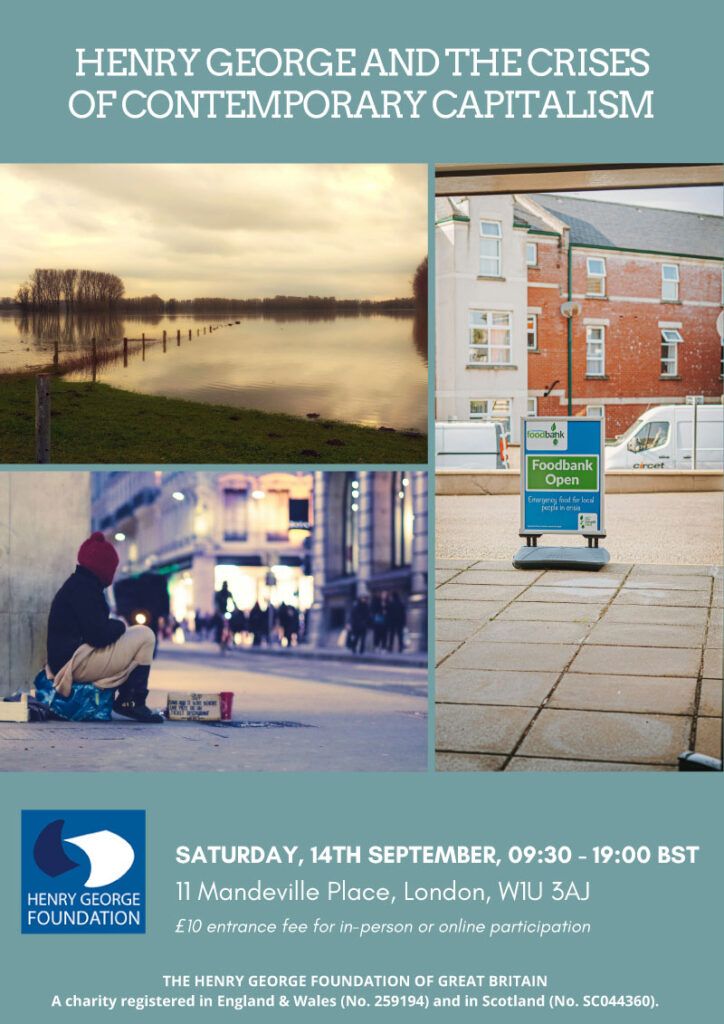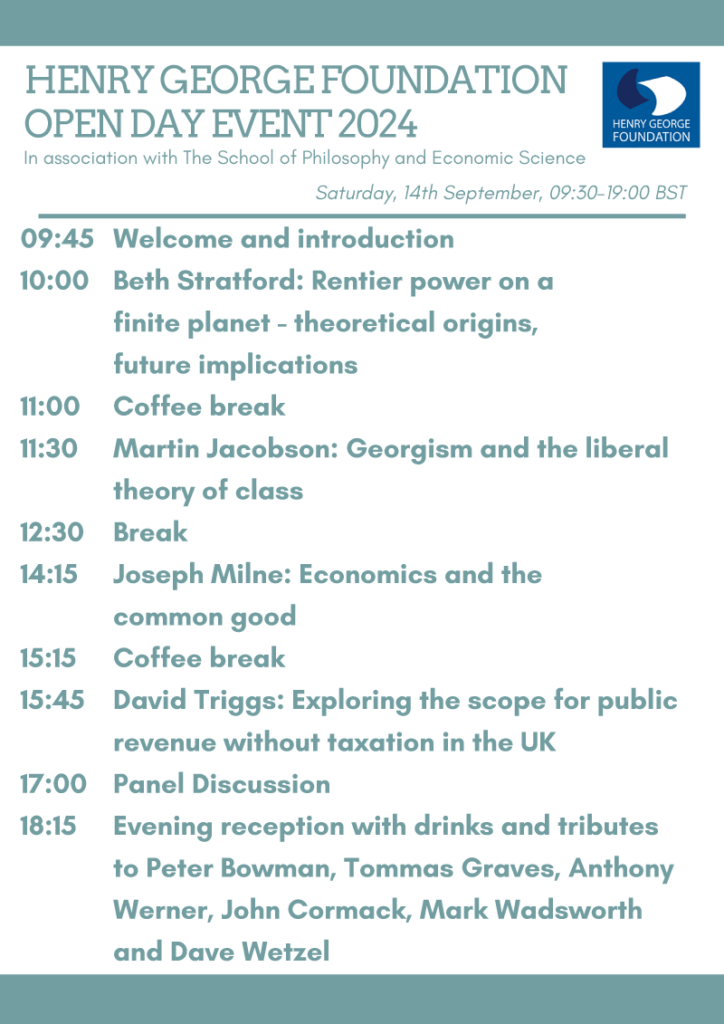
Open day event – Challenging the Monopolisation of Power and Property
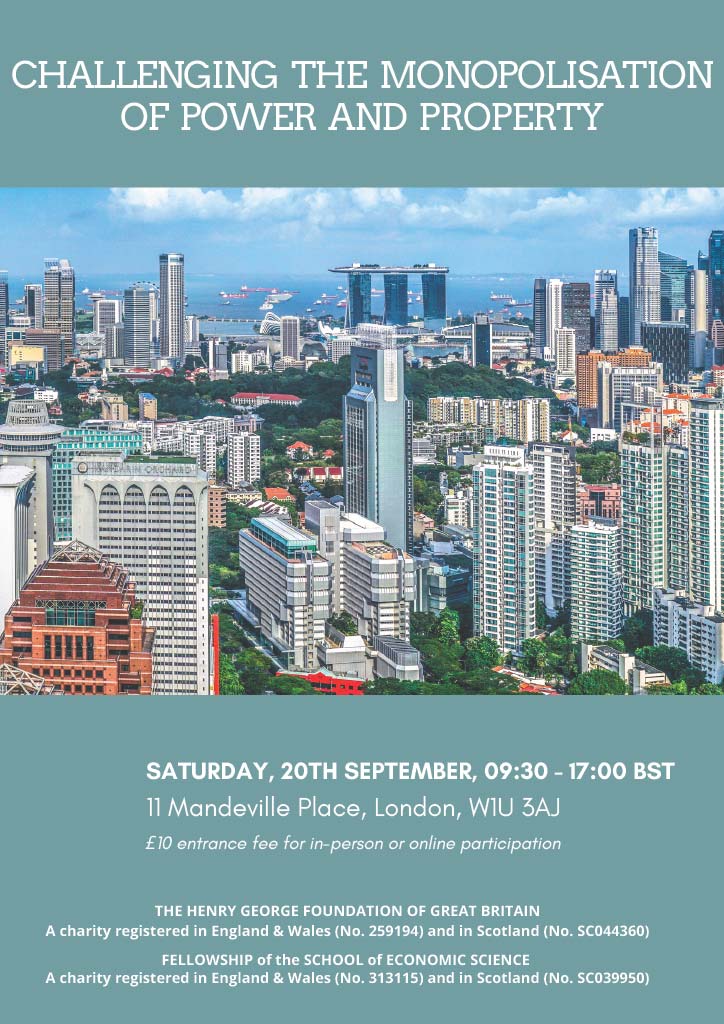
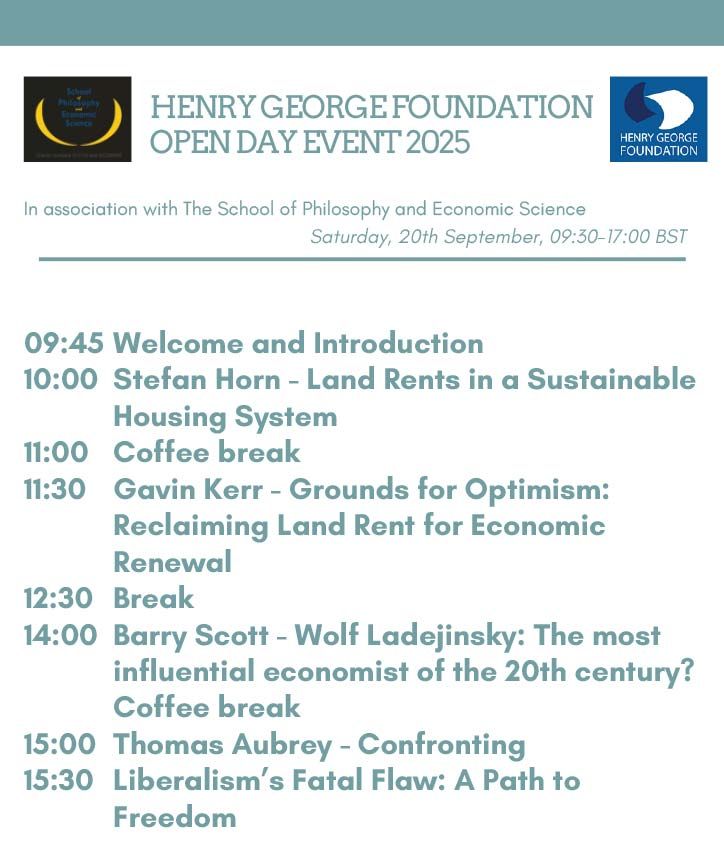
Please use this link to purchase tickets:
https://schoolofphilosophy.org/products/hgf-open-day-event-2025
—
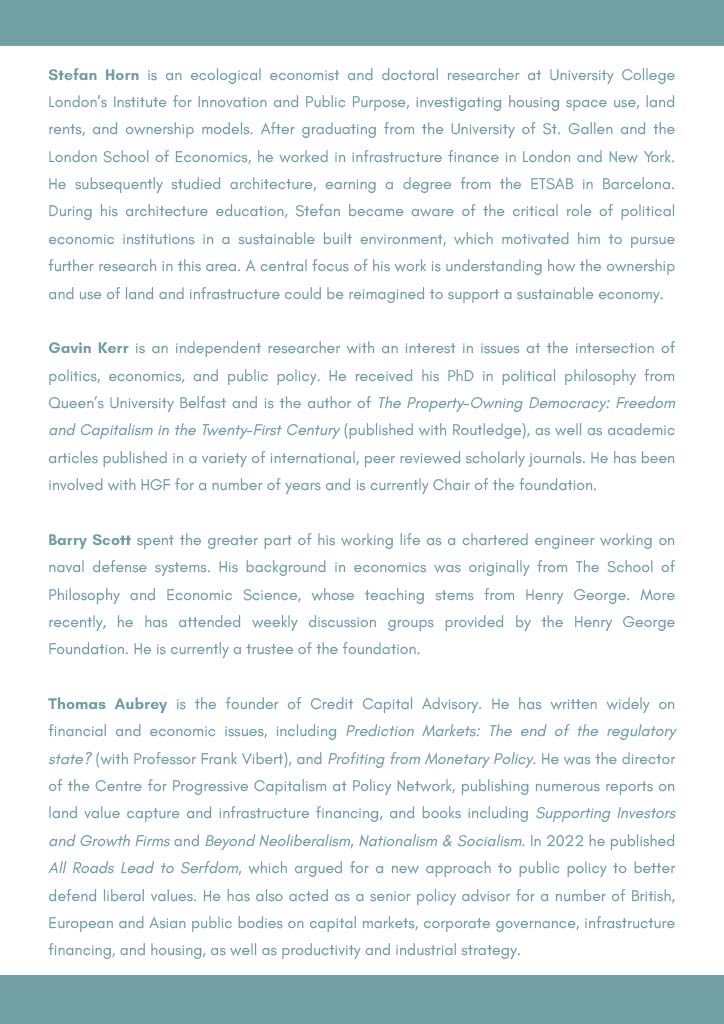
Please use this link to purchase tickets:
https://schoolofphilosophy.org/products/hgf-open-day-event-2025
—
What is Land Value Tax, and why is it such an imprtant idea? This excellent new website will tell you everything you need to know.
Saturday 24th September 2022
09:15am to 6:00 pm
Join via Zoom
Meeting ID: M890 7095 6150; Passcode: 042170
Admission Free – voluntary donations via website welcome
The work of Henry George is commonly associated with the idea of land value taxation – the ‘single tax’ on the rental value of land that would replace the unjust and inefficient taxation of production and employment. However, George was concerned not just with land rent and the land monopoly, but with monopolies and rents of all kinds, as well as wider themes concerning the ethical foundation of the economy and its place within society.
At this year’s event there will be a broad focus on the place of the economy in society, and on economic rents arising in a variety of sectors of the economy, including banking and finance, the utilities, and intellectual property.
Do join us as we explore the reasons why the ideas expressed by George in the late nineteenth century are more relevant than ever in the era of rising inflation, falling living standards, economic instability, and rapidly deteriorating environment in which we find ourselves.
| Programme | |
| 09.15 | Welcome and Introduction |
| 09:30 | John Christensen: “Vested Interests and the Common Good” |
| 10.30 | Break |
| 10.45 | David Triggs: “Monopolisation of Natural Resources and the Energy Affordability Crisis” |
| 11.45 | Break |
| 12.00 | Joseph Milne: “Henry George and the Common Good” |
| 13.15 | Lunch Break |
| 14.00 | Frank Peddle: A celebration of the publication of The Annotated Works of Henry George Volume V: The Science of Political Economy |
| 15.00 | Rebecca Lowe: “Space invaders: Property rights on the Moon” |
| 16.15 | Break |
| 16.30 | Robert Hockett: “The Wealth of our Commonwealth: Money, Meta-Markets, and Capital Management in a Productive Republic” |
| The Friday Evening Study Group | |
| Please note the start time will be 6:45 and end at 8:15pm | |
| Political Economy | |
| A new course presented by David Triggs | |
| This five-session course will consider the principles that underlie the production and distribution of wealth within and between nations. Using UK experience as an example it considers how the health, wealth, prosperity, peace and happiness of its people are affected by the extent to which those principles are recognised in current socioeconomic arrangements. | |
| 25/10/2019 | Session 1. Introduction. The Issues and Overview: The scope of the course and the relevance of political economy to today’s key issues: Living and the Making of a Living, Employment, Housing, Trade, Boom/Bust, Sustainability, the Environment, Conflict/War and Peace etc. The language of Political Economy – the meaning of key terms in order to avoid confusion with their meanings when used colloquially, by the media, or by different schools of economic thought. |
| 01/11/2019 | Half Term: no meeting |
| 08/11/2019 | Session 2. The Production of Wealth. Essential Factors (Land, Labour & Capital), their nature and interaction. Different modes of production. The impact of population growth, specialisation, the development of new technologies and sources of energy. |
| 15/11/2019 | Session 3. The Distribution of Wealth. The earnings of Labour and Capital, The Rent of Land. The impact of taxes, profits and monopolies. |
| 22/11/2019 | Session 4. The Exchange of Wealth. Trade, specialisation, credit, money. Barriers to trade, protection or free trade. |
| 29/11/2019 | Session 5. Conclusions and Possible Remedies. Fiscal and monetary reform, freedom and economic justice, global and environmental implications. World Peace? |
| ALL WELCOME | |
| You may attend one session or as many as you wish | |
| ADMISSION FREE – voluntary donations please | |
| The Henry George Foundation of Great Britain is a company limited by guarantee, registered in England, company No 00956714, Charity No 259194 and in Scotland No SC0044360 |
|
| Meetings at 11 Mandeville Place, London W1U 3AJ | ||||
| Courtesy of The School of Philosophy and Economic Science | ||||
| Autumn 2019 Study Programme | ||||
| Date | Wk No | Afternoon Group | Evening Group | |
| 04/10/2019 | Fri | Wk 1 | Group Study Meeting | Study: The Condition of Labour |
| 11/10/2019 | Fri | Wk 2 | Group Study Meeting | Study: The Condition of Labour |
| 18/10/2019 | Fri | Wk 3 | Group Study Meeting | Study: The Condition of Labour |
| 25/10/2019 | Fri | Wk 4 | Group Study Meeting | Political Economy – A new Course |
| 01/11/2019 | Fri | Wk 5 | Half Term: no meeting | Half Term: no meeting |
| 08/11/2019 | Fri | Wk 6 | Group Study Meeting | Political Economy – A new Course |
| 15/11/2019 | Fri | Wk 7 | Group Study Meeting | Political Economy – A new Course |
| 22/11/2019 | Fri | Wk 8 | Group Study Meeting | Political Economy – A new Course |
| 29/11/2019 | Fri | Wk 9 | Group Study Meeting | Political Economy – A new Course |
| STUDY GROUP: 2:30pm to 4pm: Presenter: Tommas Graves. |
||||
| Continuing from the Summer term, the Afternoon Study Group sessions will resume its study of George’s Our Land and Land Policy. Following on, the study will focus on further texts drawn from Vol 1 in the new Schalkenbach editions of The Annotated Works. | ||||
|
STUDY GROUP: 6:40 to 8:10pm |
||||
| During the first three weeks, David will lead the Group in further examination of George’s letter to Pope Leo XIII entitled The Condition of Labour, which was started in the Summer Term. | ||||
|
NEW 5 WEEK COURSE: Beginning on the 25th October, David will present a new 5-week course he has devised on Political Economy. This will continue after the half term. Further announcement later. |
||||
| ALL WELCOME | ||||
| You may attend one session or as many as you wish | ||||
| ADMISSION FREE – voluntary donations please | ||||
| The Henry George Foundation of Great Britain is a company limited by guarantee, registered in England, company no 00956714, Charity No: 259194 and in Scotland SC0044360 |
||||
Open Event September 22nd
Henry George’s published works resonant with the Early Christian teaching on the Common Good?
Key to understanding Henry George’s message is an appreciation of how ideas about ownership underpin commonly held notions regarding theft and property rights as distinct from such concepts as usufruct or the duties associated with stewardship. Such ideas are rooted in what people believe themselves to be and what is their own. It is thus important not only for political economists but for philosophers and theologians as well.
In this year’s “Open Event” we shall explore this topic from the same viewpoint Henry George recognised as important i.e. biblical teachings embodied in the old and new testaments. We shall examine the commonality of this viewpoint with that of the early Fathers of the Church as distinct from later doctrines adopted by the main stream churches, in particular, the doctrine which provoked George to write his long open letter to Pope Leo XIII in 1891. This letter was published in book form as The Condition of Labour.
Guidance in all of this comes from Charles Avila, a Filipino Georgist, rebel against the oppressive Marcos dictatorship, academic, and cleric. Fifty years ago, he produced a study “Towards a Philosophy of Ownership”. Fifteen years later his book was published under the title Ownership: Early Christian Teaching.
We shall explore both these approaches during our event. In the morning Joseph Milne will present a paper on “Ownership in Early Christianity and the Natural Law Tradition” and Simon McKenna will discuss “Christian Arguments for Justice in Land in the Context of the History of Western Political Philosophy”. In the afternoon David Triggs will share his recent meeting and interview with Charles Avila who we also plan to link with live from the Philippines.
With the help of Frank Peddle, the Series Co-editor of The Annotated Works of Henry George,we shall then discuss the same issues in the context of George’s letter to the Pope as we mount the UK launch of Volume III of this series which features The Condition of Labour, along with George’s Social Problems.
There will be opportunity for responses and questions from the floor regarding the practical and spiritual implications of the philosophy that underpinned Henry George’s approach to the science of political economy.
There will also be plenty of time for social interaction and networking both during the day and as we enjoy social drinks at the conclusion.
Venue: 11 Mandeville Place, London, W1U 3AJ
(Courtesy of The School of Economic Science)
Saturday 22 September 2018
10:00am to 6:15pm (Registration from 09:30)
Eventbritebooking required: click here
A talk by Dr Joseph Milne Monday
19th March 2018
Registration 6:40pm for Lecture at 7:00pm
Free Entry and Everyone is Welcome
Booking Required: eventbrite
This talk will explore the reasons why a wealthy nation like the UK fails to meet the housing needs of its citizens. It will demonstrate how the current housing market distorts the proper functioning of a free economy and is the root cause of the increasing gap between rich and poor. It will show how the commodification of land turns the competitive market into a monopoly over the citizen’s natural right to a home. Finally, it will argue that there are natural economic laws which, if understood and applied, would remedy the housing crisis and assure that the economy could function freely and for the common good. If you seek to explore Economics and the Social Sciences and to bring even accepted theories to the test of first principles, then this talk is for you.
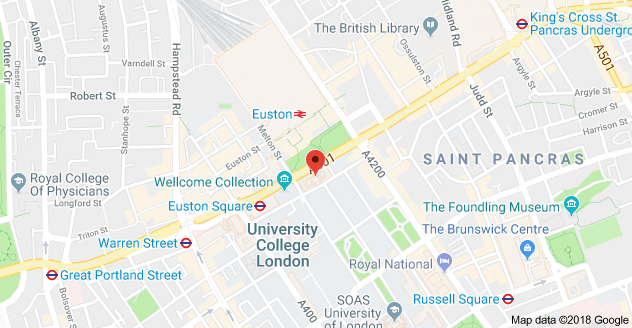
The talk will be delivered at Friends House, Hilda Clark Suite, 173, Euston Road, London NW1 2BJ

The nearest tube stations are Euston and Euston Square, which are on the Northern, Victoria, Metropolitan, Circle, Hammersmith & City lines and overground.
Talk given to the Henry George Foundation by Joseph Milne 17th March 2017
In Progress and Poverty Henry George frequently calls upon the ‘laws of nature’ or ‘natural law’, or upon universal justice. I would like to explore what he really means by these expressions. One does not find them in current economic theory. Occasionally one hears a politician calling for justice, but often this is more a call for retribution rather than justice. But one never hears them invoke the ‘laws of nature’ or ‘natural law’. Find the full article here.